
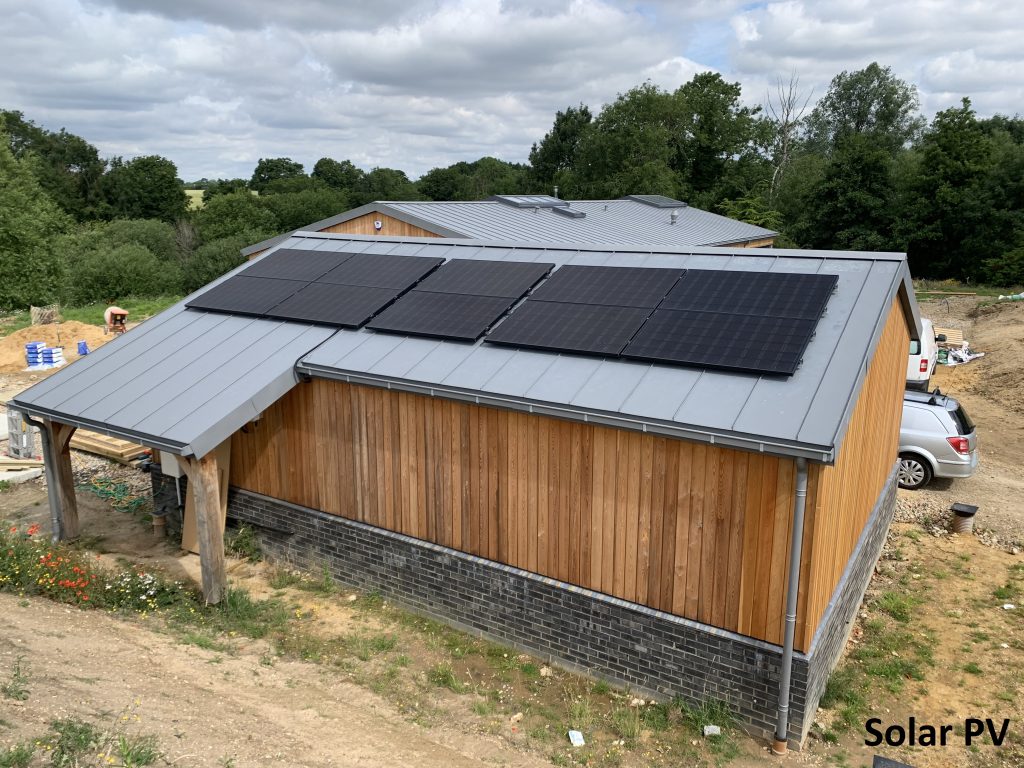
Traditional solar panels fall into two categories; PV (photovoltaic) panels, generating electricity, are the most common type you see on rooftops. Solar thermal panels, which generate hot water (mainly for domestic use), are also quite common and have been around for a long time.
PVT panels are a combination a both. The panels have a top layer of solar PV cells to generate electricity, behind which sits a thermal collector that uses the sun’s warmth to heat water.
The heated water from the PVT panels can be used for various purposes. In the renewable systems Better Planet designs and installs, we primarily use the T part of PVT: combining the generated heat with ground collectors in Ground Source Heat Pump (GSHP) systems, and for swimming pool heating.
Generation of electricity and hot water from PVT panels is seasonal in the UK as the intensity of solar radiation varies over the year. Whilst generation is quite marginal from November to February, it increases during the spring and peaks during the summer.
Electricity generation from the PV part of the panels decreases when the PV cells heat up. PVT panels solve this: by removing heat from the thermal layer beneath the solar cells to heat the water, the cells are kept cooler, which increases generation.

Pool heating with PVT panels
PVT panels are great for pool heating, especially for outdoor pools used mainly in the summer when the output from the panels peak. The PVT panels connect to a pool heat exchanger via pipes filled with a heat transfer liquid, transferring heat directly to the pool heater.
In some cases, this can be enough to achieve comfortable pool temperatures. For larger pools, an additional heat source in the form of a heat pump might be required. As heat pumps use electricity they will directly benefit from the electricity generated by the PVT panels. The result is a very energy efficient way of heating the pool.
PVT panels integrated with ground source heat pump systems
Ground source heat pumps use thermal energy from the ground collected in a ground collector consisting of pipework buried in the ground, either via vertical boreholes or horizontal loops. The pipework is filled with a heat transfer liquid, called brine, moving the heat from the ground to the heat pump.
The ground has a relatively stable temperature and is therefore a reliable source of heat throughout the year. The heat from the PVT panels, on the other hand, is much more seasonal. In spring, summer and autumn, there will often be conditions when the heat transfer liquid from the PVT panels is warmer than the heat transfer liquid from the ground collector. In such conditions, heat from both the ground collector and the PVT panels can be used by the ground source heat pump. Better Planet has developed a control system that manages the flows from the respective source to optimize the efficiency of the system, reducing running costs.
For some new systems, we sometimes size the ground collectors without considering the heat contribution from the PVT panels. We then get a system with higher efficiency than one only relying on the ground collector. For projects where land available for ground collectors is limited, we add heat from PVT panels aiming for similar efficiency as a system with only ground collectors.
In summary, combining ground collectors with PVT panels in a multisource heat pump system can be more efficient and less expensive than a system only relying on ground collectors.
Using PVT panels to upgrade existing ground source heat pump systems with undersized ground collectors
In the UK there are, unfortunately, many existing ground source heat pump systems with undersized ground collectors. These systems have lower efficiency, higher running costs and higher likelihood of breakdowns. The performance of these systems is characterised by low brine temperatures in the winter (lower than 0°C) and sometimes falling ground temperatures year-on-year as ground temperatures fail to recover in the summer. In the worst cases this results in “permafrost” gardens where nothing can grow as the soil is too cold.
At Better Planet, we are regularly contacted by clients with such a system often installed by companies which have ceased trading. Adding a PVT system can significantly improve the average efficiency of the system over the year. It is also a back stop against year-on-year degradation due to the abundance of heat from the PVT panels in the summer.
We’re here to help!
Whether you are planning a new build, looking for an efficient way to heat a swimming pool, or need to rescue an underperforming ground source heat pump, we have the expertise to assist.
Our team can model your specific project to demonstrate exactly how integrating PVT panels can reduce your running costs and improve system longevity.
If you would like to discuss a new project or need support with an existing system, please contact us today.